

Profit Margin Calculator
Use our profit margin calculator to quickly determine how profitable your products or services really are. Simply enter your cost and revenue to get clear margin results, helping you price smarter and make confident business decisions.


Profit Margin
This calculator is provided for general information and illustration purposes only. Please verify all results with a licensed contractor, as actual project requirements may vary.

What is Profit Margin and why it matters for small businesses
Profit margin shows how much money your business actually keeps after covering all costs. Unlike revenue, which only reflects how much you sell, profit margin reveals whether your business model is truly sustainable.
For small businesses, profit margin often matters more than growth. Many businesses increase sales year over year but still struggle financially because their margins are too thin to absorb rising costs, unexpected expenses, or slower periods.
This calculator helps you understand whether your pricing and cost structure are working in your favor—or quietly working against you.
Calculation formula
Profit margin is calculated by comparing profit to revenue, expressed as a percentage.

Where Revenue is total sales, and Profit is revenue minus all costs and expenses.
For example, your business generates $10,000 in revenue in a month.
Your total costs and expenses (including materials, labor, software, and overhead) add up to $7,500.
•Revenue = $10,000
•Profit = $10,000 − $7,500 = $2,500
Now apply the formula:
Profit Margin (%) = (Profit / Revenue) × 100
Profit Margin (%) = (2,500 / 10,000) × 100 = 25%
This means that for every dollar you earn in revenue, $0.25 is profit, after all costs and expenses are covered.
Key features of costs
•Labor Cost: Wages, salaries, contractor fees, and any payments related to the time people spend producing or delivering your product or service. This may also include benefits, payroll taxes, or commissions.
•Materials Cost: The direct materials or supplies required to create your product or complete your service. For product-based businesses, this includes raw materials or inventory. For service businesses, it may include consumables or tools used per job.
•Overhead Expenses: Ongoing operating costs that are not directly tied to a single sale, such as rent, utilities, software subscriptions, insurance, marketing, accounting, and administrative expenses. These costs must still be covered by your revenue and significantly impact profit margin.
•Travel Cost: Transportation, accommodation, meals, and other travel-related expenses incurred while serving clients, meeting partners, or managing operations. These costs can add up quickly, especially for service-based or remote work.
Profit Margin vs Revenue: A common misunderstanding
Revenue answers one question: How much did you sell?
Profit margin answers a more important one: How much did you actually keep?
It’s possible to:
- Increase revenue while profit margin shrinks
- Work more hours but earn less per dollar sold
- Appear “busy” but remain financially fragile
Profit margin exposes these problems early, before they turn into cash flow issues.
Typical Profit Margin ranges by industry(U.S.)
Profit margins vary widely by industry, business model, and location. That said, many small business owners find it helpful to compare their numbers to broad industry ranges.
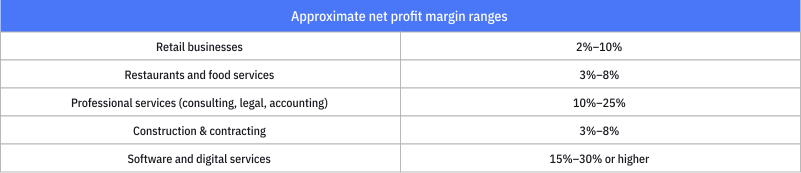
Please note that these figures are based on industry averages and can vary significantly depending on the specific company, its size, location, competition, and other factors. They are benchmarks, not targets. Your ideal profit margin depends on factors such as operating costs, pricing power, competition, and growth goals.
If your margin is lower than industry averages, it doesn’t always mean something is wrong. Common reasons include:
- High upfront costs or recent investments
- Aggressive pricing to gain market share
- Seasonal revenue fluctuations
- Inefficient overhead or underpriced services
The goal is not to match an average, but to understand whether your margin supports long-term stability.
Common Profit Margin mistakes
Even experienced business owners can misunderstand profit margins. Here are some of the most common mistakes to watch out for:
•
Confusing markup with profit margin
Markup and profit margin are not the same. Markup is based on cost, while profit margin is based on revenue.
Mixing the two can lead to underpricing and inaccurate profitability expectations.
•
Ignoring overhead costs when pricing
Focusing only on direct costs (like materials or labor) while overlooking overhead expenses—such as software subscriptions, rent, marketing, or administrative costs—can make margins look healthier than they actually are.
•
Looking only at revenue growth
Growing revenue does not always mean growing profits. If costs increase at the same pace—or faster—your profit margin may shrink even as sales rise.
•
Comparing margins without considering business model differences
Profit margins vary widely by industry and business model. Comparing your margins to businesses with different cost structures, pricing strategies, or scale can lead to misleading conclusions.
How to use Profit Margin to make better decisions
Your profit margin is more than just a number—it’s a practical tool for making smarter business decisions, such as:
•
Identifying underpriced products or services
Low margins can highlight products or services that are not priced appropriately relative to their costs.
•
Deciding when to raise prices
If margins are consistently thin, it may be a signal that your pricing no longer reflects your value or rising expenses.
•
Evaluating cost-cutting opportunities
Tracking margins over time can help you spot inefficiencies and identify areas where costs can be reduced without hurting quality.
•
Planning for hiring or expansion
Strong, stable margins indicate whether your business can support new hires, investments, or growth initiatives.
A healthy profit margin gives you flexibility and room to grow.
A thin margin limits your options—even when sales appear strong on the surface.
Other Free Resources

Try Invoice Zip Today
Start Sending Invoices, Building Reports, Saving Office
Time and Get Paid Faster.